
What Are Circuit Exercises? Benefits & Workouts
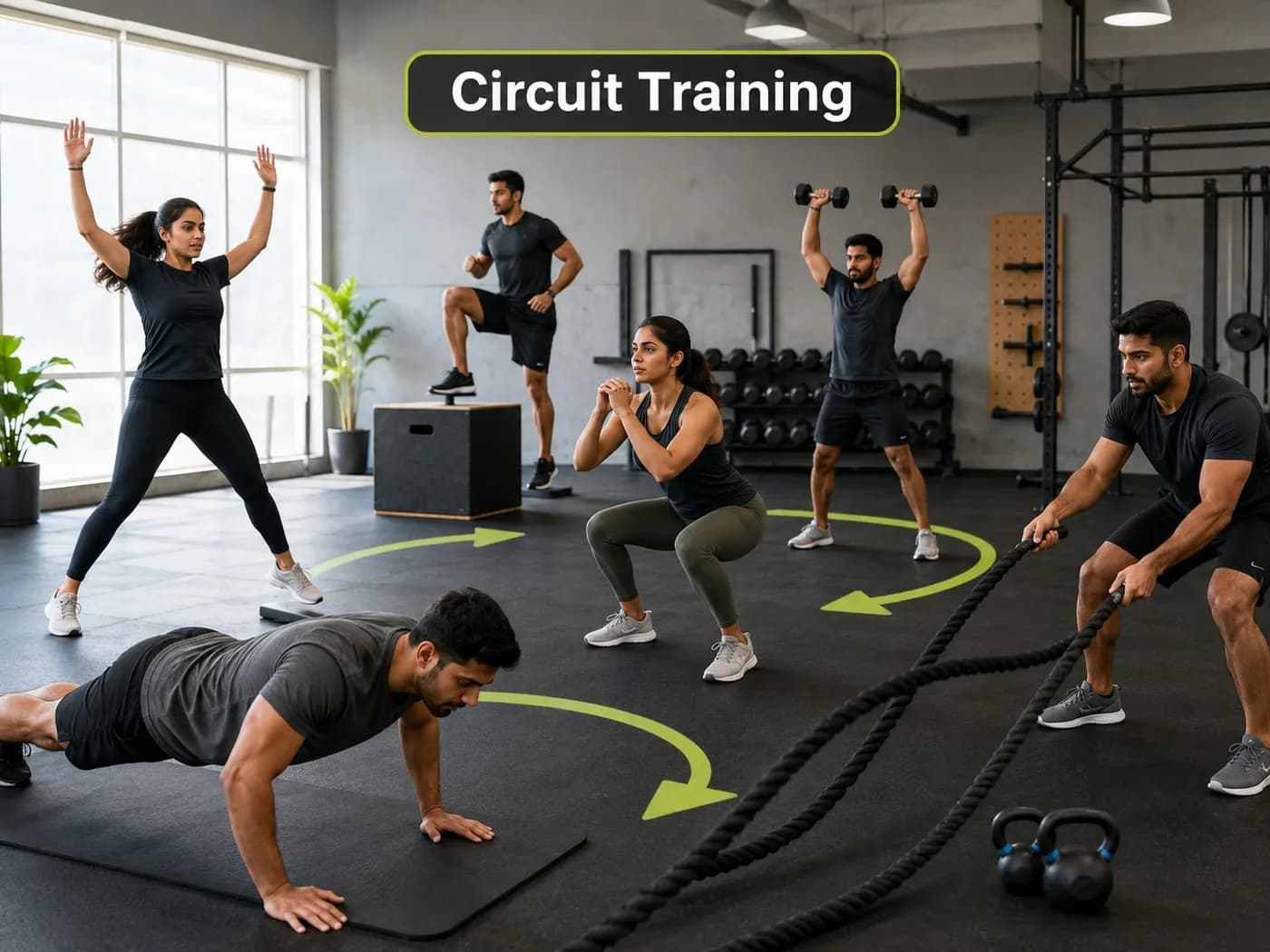
Performing 5 to 8 different moves back-to-back with minimal rest, then repeating the sequence, builds strength and raises your heart rate in one 20-30 minute session. See the benefits and workouts.
Key Takeaways
- Involves 5 to 8 different moves performed back-to-back with minimal rest between them.
- The full sequence is typically repeated 2 to 3 times after a short break.
- Delivers a full-body session in just 20 to 30 minutes total.
- Keeps the cardiovascular system engaged while muscles work under tension simultaneously.
- Most moves – squats, lunges, push-ups, rows – mimic real-life movement patterns.
- Scales easily using only bodyweight, a pair of dumbbells, or resistance bands.
Circuit exercises are a workout format where you perform 5 to 8 different moves back-to-back with minimal rest, then take a short break and repeat the sequence 2 to 3 times. This builds strength, raises your heart rate, and delivers a full-body session in 20 to 30 minutes, making it efficient for fat loss, conditioning, and functional fitness.
If you've ever wondered what are circuit exercises and why fitness coaches recommend them for strength, fat loss, and conditioning, you're in the right place. Circuit training is a structured way of moving through several different exercises back-to-back, with little or no rest between them, before taking a short break and repeating the sequence. The result is a single workout that builds muscle, raises your heart rate, and saves time — all without needing a fully equipped gym.
This guide breaks down how the circuit training method works, the best moves to include, who it suits, and how to start a sustainable routine from home.
Top 5 Benefits of Circuit Training
- Builds Strength and Endurance Together Because you move from one exercise to the next with minimal rest, your muscles work under tension while your cardiovascular system stays engaged. Over weeks of consistent practice, this dual stimulus supports gradual gains in both muscular strength and stamina.
- Time-Efficient for Busy Schedules A complete circuit can be done in 20 to 30 minutes. For working professionals, parents, or anyone short on time, this format delivers a full-body session without the long gym hours.
- Supports Healthy Fat Loss The continuous movement keeps your heart rate elevated, which means you burn more calories per minute compared to traditional rest-heavy weightlifting. Paired with consistent practice, circuit training complements your fat-loss journey.
- Improves Functional Fitness Most circuit moves — squats, lunges, push-ups, rows — mimic real-life movement patterns. Practising them regularly helps you carry groceries, climb stairs, and move through daily life with less effort.
- Easy to Scale for Any Fitness Level You can build a circuit using only your body weight, a pair of dumbbells, or resistance bands. The format adapts as you grow stronger, which is one reason strength training coaches lean on it heavily for beginners and advanced lifters alike.
How to Get Started with Circuit Training
What You Need to Begin
You don't need a gym membership to start. A small open space, a mat, and optionally a pair of light dumbbells or a resistance band are enough. Many circuit training exercises are designed to be done with zero equipment, which makes this method ideal for people training at home.
Setting Realistic Goals
Start with 2 to 3 circuit sessions per week. Avoid the temptation to train every day in the first month — your muscles need recovery days to adapt. Focus on showing up consistently rather than pushing to exhaustion in every session.
Start with the Basics
Pick 5 to 6 simple exercises that cover the major movement patterns: a squat, a push, a pull, a hinge, and a core move. Perform each for 30 to 45 seconds, rest for 15 seconds, and move to the next. After completing all exercises, rest for 1 to 2 minutes and repeat the circuit 2 to 3 times.
Best Circuit Training Exercises to Try

Bodyweight Squats
Stand with feet shoulder-width apart, lower your hips back and down as if sitting in a chair, then return to standing. Aim for 12 to 15 reps. This move trains your quads, glutes, and core.
Push-Ups
A classic upper-body builder. Perform 8 to 12 reps with hands slightly wider than shoulders. Drop to your knees if needed — form matters more than reps.
Reverse Lunges
Step one leg back, lower your back knee toward the floor, and return. Alternate legs for 10 reps per side. Reverse lunges are gentler on the knees than forward lunges.
Plank Hold
Hold a forearm plank for 30 to 45 seconds. Keep your hips level and brace your core. This builds the deep stability that protects your lower back. For more on this, see our guide on core muscle exercises.
Dumbbell Rows
Hinge at the hips, hold a dumbbell in each hand, and pull the weights toward your ribs. Do 10 to 12 reps. This is one of the most useful pulling movements and pairs well with other strength training exercises.
Mountain Climbers
From a high plank, drive one knee toward your chest, then quickly switch. Continue for 30 seconds. This raises your heart rate and trains your core simultaneously.
Glute Bridges
Lie on your back, knees bent, feet flat. Lift your hips until your body forms a straight line from knees to shoulders. Squeeze and lower. Aim for 12 to 15 reps.
Common Mistakes to Avoid
- Poor Form The biggest mistake beginners make is sacrificing technique to finish more reps. Slow down. A clean squat with 10 reps is more valuable than 20 sloppy ones that strain your knees or back.
- Skipping Warm-up Circuits move fast, so cold muscles are a recipe for strain. Spend 5 minutes on light cardio and mobility drills — arm circles, hip openers, leg swings — before starting.
- Overtraining Doing circuits 6 days a week without recovery leads to fatigue, plateau, or injury. Two to four well-executed sessions per week deliver better results than daily exhaustion.
- Inconsistency The single biggest reason people don't see results isn't the workout — it's the gap between sessions. Showing up three times a week for three months will outperform a perfect plan you abandon after two weeks.
Who Should Try Circuit Training?
- Beginners Circuits remove the guesswork. You don't need to plan complex split routines — just rotate through a handful of basic moves. The simple structure helps newcomers build confidence quickly.
- Women Circuit training builds lean, toned muscle without the bulk many women worry about. It supports bone health, posture, and metabolism, especially when paired with sensible nutrition. Explore female strength training approaches for routines built around women's needs.
- Older Adults With low-impact modifications (chair squats, wall push-ups, slow tempo work), circuit exercises help older adults maintain mobility, balance, and bone density. Always check with your doctor before starting if you have existing conditions.
- Working Professionals If your day is packed and you can only spare 25 minutes, a circuit gives you cardio, strength, and core work in one shot. It's also a great counter to long hours of sitting and poor posture.
Build Strength with a Routine That Actually Works
Building strength isn't about doing random workouts — it's about consistency, guidance, and following a structured plan. With the right support, you can train effectively from home and see real progress over time.
What You Get with Habuild's Strong Everyday Program:
- Daily live guided strength and yoga sessions
- Beginner to advanced progression
- No-equipment and home-friendly workouts
- Expert guidance to ensure correct form
- Community support to stay consistent
Ready to take the next step? Explore our strength training program built for beginners and intermediates.
Start Your Strength Training Journey
Related reads: 20 Minute Full Body Workout: 10 Benefits, Best Exercises & How to Start · What Are Pelvic Exercises? Benefits, Moves & How to Start
Circuits work because they combine strength and cardio into one efficient session, but stringing random moves together rarely delivers the same results as a well-sequenced routine. The order, rest periods, and progression matter as much as the exercises themselves. Habuild's Strong Everyday program offers exactly that kind of guided structure, so every circuit session builds on the last.
What is circuit training, at its simplest? A sequence of exercises performed back-to-back with minimal rest, combining strength and cardio in one session.
Frequently Asked Questions
Related Articles

What Are HIIT Exercises? Benefits, List & How to Start
HIIT alternates intense bursts of effort with brief recovery periods — burpees, squats, mountain climbers, and high knees in a 20-30 minute session. See the benefits, list, and how to start.

What Are Burpees Exercises? Benefits & How To Do Them
A squat, a plank, a push-up, and a vertical jump combine into one continuous movement that works nearly every major muscle group with zero equipment. See the benefits and how to do them.

What Are Plyometric Exercises? Benefits & Best Moves
Explosive, jump-based moves like jump squats, box jumps, and clap push-ups train your muscles to produce maximum force in the shortest possible time. See the benefits and best moves.

Strength Training Calories Burned: How Much Does a Session Actually Burn?
Strength training burns fewer calories per session than cardio, but produces far greater long-term expenditure through the metabolic elevation it creates. See exactly how much a session burns.

What Are Compound Exercises? Benefits & Best Moves
Squats, push-ups, deadlifts, and rows work two or more muscle groups across multiple joints at once, training your body as a system. See the benefits and best moves.