
Trikonasana: Triangle Yoga Pose, Steps & Benefits
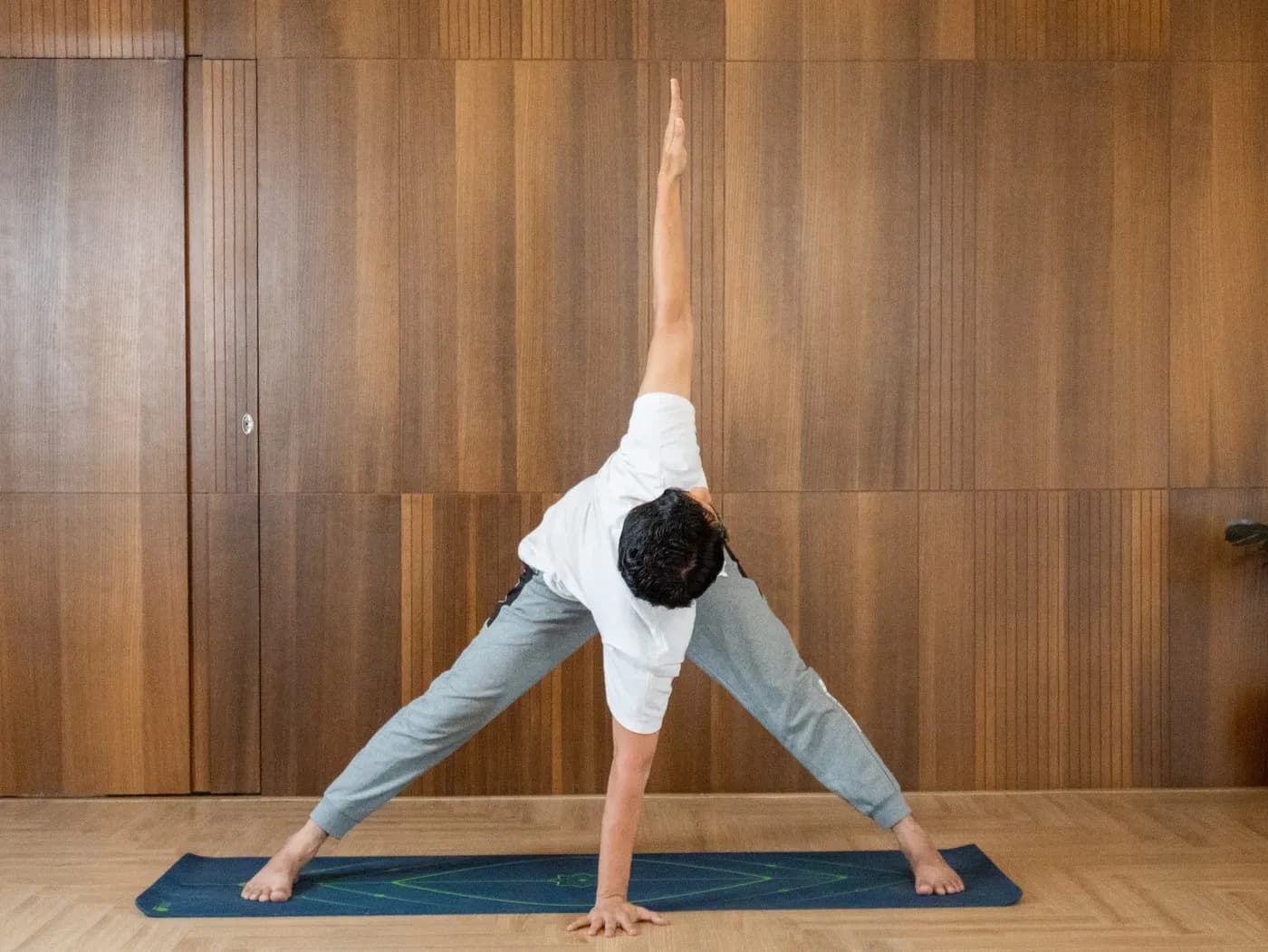
Trikonasana, the Triangle Pose, opens the hips, lengthens the lateral body, strengthens the legs and core, and improves spinal alignment in one complete standing pose.
Key Takeaways
- Three angles form from the wide-legged base, lateral torso reach, and vertical arm line.
- Feet are set roughly 3-4 feet apart with the back foot turned to a full 90 degrees.
- Addresses lateral spinal imbalances where one side sits chronically shorter than the other.
- Stretches the front hamstring, hip flexors, and entire lateral body in one single movement.
- The two arms form one continuous straight line perpendicular to the floor at full extension.
- Lateral abdominal compression supports digestion alongside its flexibility benefits.
Trikonasana — the Triangle Pose — is one of the most iconic and foundational standing poses in modern yoga, representing the stable, dynamic geometry of the triangle in the human body. It simultaneously opens the hips, lengthens the lateral body, strengthens the legs and core, improves spinal alignment, and builds the whole-body integration that makes it one of the most complete single poses in the yoga repertoire.
What is Trikonasana?
Trikonasana — pronounced tri-koh-NAH-sana — translates directly as Triangle Pose (Tri = three, Kona = angle, Asana = pose). The three angles of the triangle are formed by the wide-legged base, the extended lateral reach of the torso, and the vertical line created by the two arms — the body forming a precise geometric triangle when viewed from any direction.
In the pose, the practitioner stands with feet approximately 3–4 feet apart, the front foot pointing forward and the back foot turned to 90 degrees. The torso reaches laterally over the front leg, bringing the lower hand to the shin, ankle, or floor while the upper arm extends vertically toward the ceiling. Both sides of the waist lengthen equally, the chest opens to face the side wall, and the two arms form a single straight line perpendicular to the floor.
At Habuild, Trikonasana is taught as a cornerstone of our standing pose and hip mobility curriculum. Members building lateral flexibility and those managing hip opening stiffness find the triangle pose a foundational daily practice.
Trikonasana Benefits
Physical Benefits
- Stretches the Hamstrings, Hips, and Lateral Body — Trikonasana creates a simultaneous multi-structure stretch — the front hamstring and inner thigh opening through the lateral reach, the hip flexors releasing through the wide stance, and the entire lateral body from the outer hip to the underarm lengthening through the side bend.
- Strengthens the Legs, Core, and Spinal Muscles — The pose demands sustained muscular engagement throughout the standing leg, glutes, and core — the held lateral position requiring significant stabilising strength. The spinal extensors and lateral abdominals are simultaneously stretched and strengthened.
- Improves Posture and Spinal Alignment — Trikonasana directly addresses lateral spinal imbalances — one side chronically shorter than the other — that poor posture and asymmetric movement habits create. Regular practice restores bilateral spinal symmetry.
- Stimulates Digestion and Abdominal Organs — The lateral compression of the abdomen massages the digestive organs, supporting peristalsis and reducing the digestive stagnation that contributes to bloating and gas.
- Relieves Back Pain and Sciatic Tension — Trikonasana opens the lateral hip structures — the piriformis, IT band, and quadratus lumborum — that when tight directly contribute to lower back pain and sciatic compression.
Mental and Emotional Benefits
- Builds Confidence, Stability, and Grounded Presence — Trikonasana's wide, open standing form embodies the qualities of groundedness, stability, and expansive presence. Holding the pose with the chest open and arms extended builds physical confidence that translates into the practitioner's bearing.
- Improves Focus and Body Awareness — The precise alignment demands — both arms in one line, chest fully open, both sides of the waist long — require sustained attentional focus that builds body awareness and present-moment concentration.
How to Do Trikonasana — Step-by-Step Instructions
Key Principles
Both sides of the waist lengthen equally — the pose is a lateral reach, not a forward collapse. The chest opens fully to face the side wall throughout. The lower hand rests lightly — it does not bear the weight of the torso. The back leg remains strong and straight as the anchor of the entire pose.
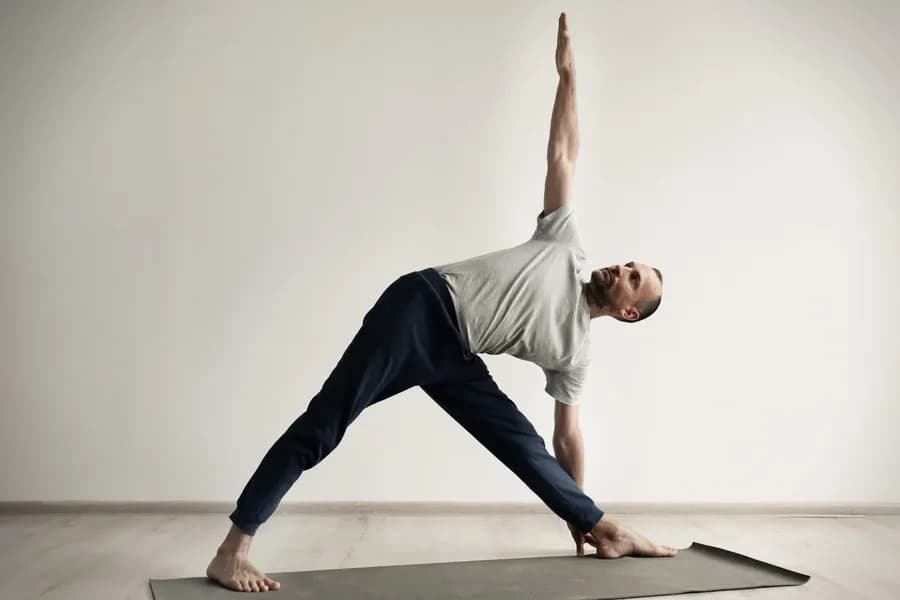
Step 1: Starting Position — Stand in Tadasana at the top of the mat. Feet together, spine tall, arms at the sides. Establish steady breathing before stepping into the pose.
Step 2: Step the Feet Wide Apart — Step the feet 3–4 feet apart. Extend the arms horizontally at shoulder height, parallel to the floor. Both feet are fully grounded.
Step 3: Turn the Right Foot Out, Left Foot In — Turn the right foot to 90 degrees and the left foot inward to 15–30 degrees. Align the right heel with the arch of the left foot. Both legs remain fully extended.
Step 4: Reach Right and Hinge Laterally — Inhale, extend the torso laterally to the right. Exhale and bring the right hand to the shin, ankle, or floor outside the right foot. The torso moves sideways — not forward.
Step 5: Open the Chest and Extend the Left Arm — Rotate the chest to face the left wall — opening fully to the side. Extend the left arm straight up. Both arms form a single vertical line perpendicular to the floor. Gaze toward the upper thumb or forward if the neck is sensitive.
Step 6: Hold, Then Switch Sides — Hold for 5–8 breaths — both sides of the waist long, chest fully rotated open. Inhale, press through the back foot, and rise to standing. Repeat on the left side.
Breathing in Trikonasana
Inhale to create length through the upper arm. Exhale to settle deeper without collapsing the waist or losing chest rotation. Maintain steady Ujjayi breathing throughout to sustain the muscular engagement holding the pose's precise geometry.
Preparatory Poses Before Trikonasana
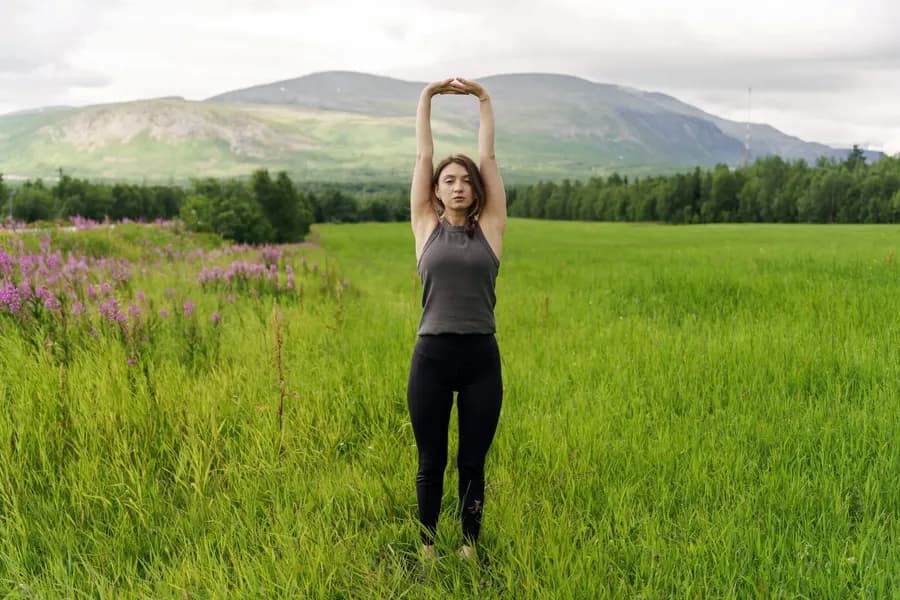
- Tadasana (Mountain Pose, 5 breaths) — Establishes spinal alignment and active feet before the wide-legged standing pose.
- Virabhadrasana II (Warrior II, 5 breaths each side) — Opens the hip flexors and activates the lateral body before the triangle's lateral reach.
- Prasarita Padottanasana (Wide-Legged Forward Fold, 5 breaths) — Warms the inner thighs and hamstrings required for the wide stance.
- Utthita Parsvakonasana (Extended Side Angle, 5 breaths each side) — Opens the lateral body with knee support before the straight-leg demand of the triangle pose.
Variations of Trikonasana
- Variation 1: Trikonasana with Block — Beginner — Place a yoga block on its highest setting outside the front ankle and rest the lower hand on it. This raises the floor and allows the chest to open and both sides of the waist to lengthen correctly — without hamstring tightness forcing a forward collapse.
- Variation 2: Parivrtta Trikonasana (Revolved Triangle) — Intermediate — The torso rotates in the opposite direction — the opposite hand reaching to the floor beside the front foot while the other arm extends upward. Adds deep spinal rotation, thoracic mobilisation, and detoxifying abdominal compression.
- Variation 3: Baddha Trikonasana (Bound Triangle) — Advanced — From full Trikonasana, the upper arm wraps behind the back and the lower hand releases the shin to bind the two hands behind the back. Deepens shoulder and thoracic rotation.
Common Mistakes to Avoid in Trikonasana
- Collapsing the torso forward instead of reaching laterally — Trikonasana is a pure lateral reach in a single plane. Forward collapse loses the lateral body lengthening that is the pose's primary structural benefit.
- Lower hand bearing the weight of the torso — The lower hand rests lightly — the pose is held by the legs and core, not the arm. Pressing into the lower hand collapses the chest and shortens the lower waist.
- Back leg softening or the knee bending — The back leg is the anchor of the pose — fully extended and strongly engaged throughout.
- Chest facing down instead of opening to the side — The chest must rotate fully to face the side wall. A downward-facing chest indicates insufficient thoracic rotation.
- Forcing the hand too far down before the body is ready — Begin with the hand at the shin and use a block until the full range of motion develops naturally.
Who Should Practise Trikonasana?
- Those with Back Pain and Lateral Spinal Imbalance — Trikonasana directly addresses the lateral spinal asymmetries and quadratus lumborum tightness that contribute to back pain — restoring the bilateral spinal balance that lower back pain management requires.
- Athletes Seeking Lateral Mobility and Hip Flexibility — For runners, cyclists, and athletes whose training is dominated by forward-facing movement, regular triangle pose practice addresses the lateral hip, IT band, and thoracic rotation restrictions that cause injury and reduce performance.
- Is Trikonasana Good for Beginners? — Yes — with a block under the lower hand, Trikonasana is fully accessible from the first session regardless of hamstring flexibility.
Make Trikonasana a Part of Your Practice
Trikonasana is among yoga's most complete standing poses — stretching the hamstrings, hips, and lateral body; strengthening the legs and core; improving spinal alignment; and building the grounded, expansive presence that the triangle's geometry embodies.
Whether you are a complete beginner working with a block, a desk worker reversing the lateral postural imbalances that sitting creates, or an intermediate practitioner exploring the demanding rotation of parivrtta trikonasana, the triangle pose rewards consistent daily practice with progressive and lasting physical transformation.
The most effective way to learn the correct lateral reach, chest rotation, and back leg engagement is under live guidance with real-time corrections.
Start your 14 day free yoga journey with Habuild, today!
Related reads: Utthita Trikonasana (Extended Triangle Pose): Steps, Benefits & Precautions · Parivrtta Trikonasana (Revolved Triangle): Steps and Key Benefits
Triangle Pose is a staple for a reason: the leg strength and balance it builds come from returning to it regularly, letting your body find better alignment each time rather than forcing a deeper stretch once. Trikonasana practised occasionally stays a decent stretch; practised consistently, it becomes a genuine strength and flexibility tool. Habuild's Yoga Everyday program keeps foundational poses like this in rotation as part of a complete daily flow.
Frequently Asked Questions
Related Articles

Tadasana — The Mountain Pose
Tadasana, or Mountain Pose, is the quiet foundation every standing yoga pose is built on — simple to look at, precise to get right.

Adho Mukha Svanasana — The Downward-Facing Dog Pose
Adho Mukha Svanasana, universally known as Downward-Facing Dog, is one of yoga's most iconic and versatile postures.
Marjaryasana–Bitilasana — The Cat–Cow Pose
Marjaryasana–Bitilasana, commonly known as Cat–Cow Pose, is a gentle, dynamic flow between two postures that warms up the body and brings flexibility to the entire spine.
Bhujangasana: Cobra Pose Steps, Benefits & Tips
Bhujangasana, or Cobra Pose, strengthens the spine and entire back musculature, opens the chest, stimulates abdominal organs, and corrects the postural damage of prolonged sitting.
Vakrasana: Twisted Pose, Steps & Yoga Benefits
Vakrasana, or Twisted Pose, is a seated spinal rotation that improves spinal flexibility, stimulates digestive organs, and strengthens the core.